
First Time Home Buyers
Taylor made bespoke mortgage solutions from newlyweds to growing families to those who want to enjoy their retirement. Click below for a no obligation call.

The First-Time Buyer Process
1. Get pre-approved and understand your numbers.
2. Build a comfortable—not just maximum—home-buying budget.
3. Review your FHSA, RRSP/HBP, down payment and available rebates.
4. Find the right home and consider renovation potential.
5. Make an offer with appropriate conditions and professional advice.
6. Submit the property for final mortgage approval.
7. Complete lender conditions, appraisal and documentation.
8. Work with your real estate lawyer on closing.
9. Get your keys and start building your future.
Mortgage Pre-Approval: Start Here
A pre-approval helps you understand your potential borrowing range, estimated payment, available mortgage options and how much cash you may need. It also lets you shop with more confidence.
A pre-approval is not the same as final mortgage approval. The property, appraisal, documentation and your financial situation may still need to satisfy the lender before closing.
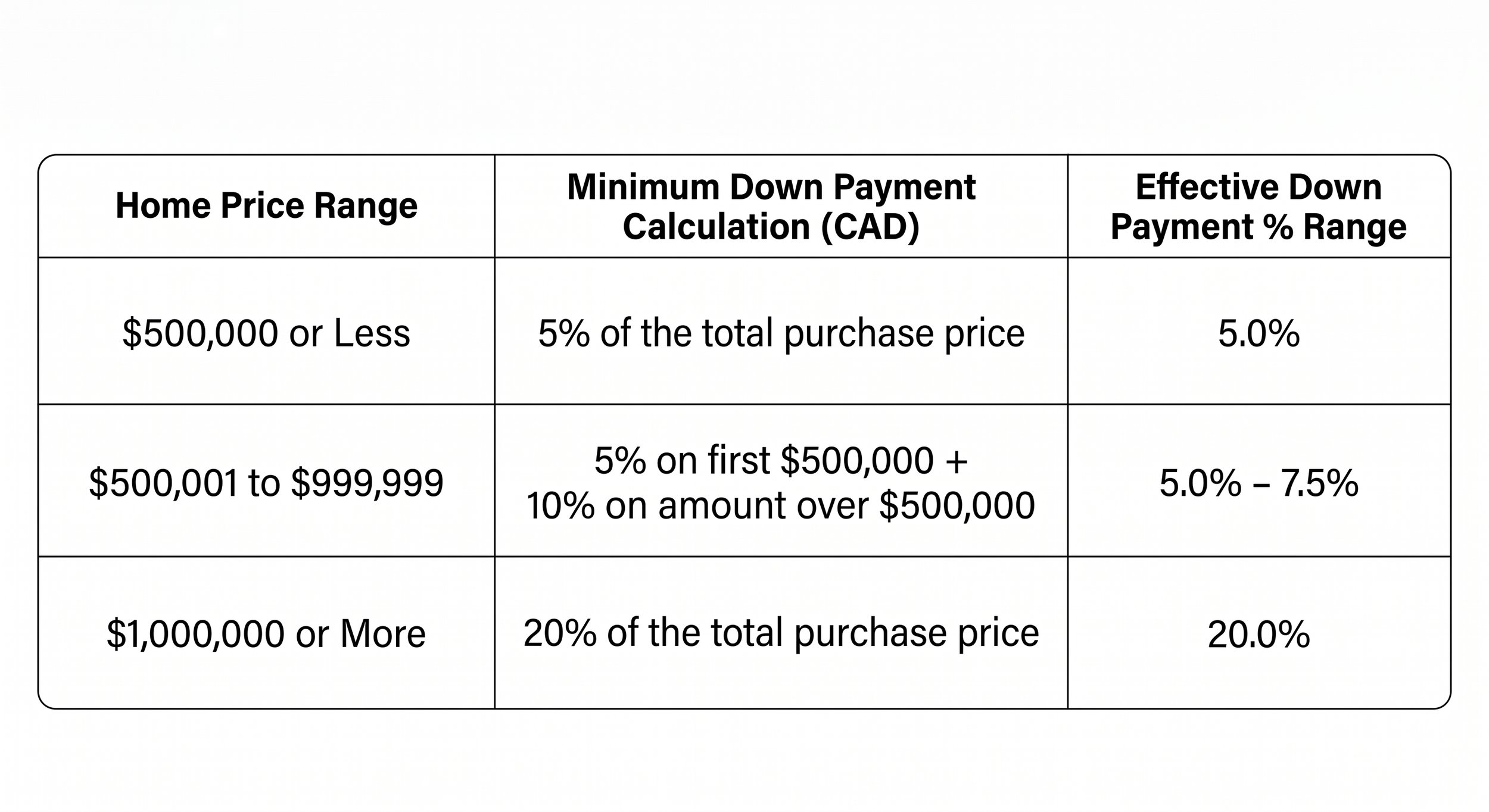
How Much Do You Need for a Down Payment?
You do not necessarily need 20% down. For an eligible insured homeowner mortgage, the minimum down payment generally starts at 5%.
For insured homeowner mortgages, the maximum purchase price/lending value is below $1.5 million. For example, for a $700,000 purchase price, you would need $45,000 as the minimum down payment. Here’s a table which shows you all 3 tiers.
Why Can an Insured Mortgage Have a LOWER Rate?
This surprises many first-time buyers. You might think a smaller down payment should mean a higher mortgage rate. Not necessarily.
Because mortgage insurance reduces the lender’s risk, insured mortgages can receive very competitive pricing. CMHC specifically notes that mortgage loan insurance helps borrowers with smaller down payments obtain a reasonable interest rate. In some situations, the interest savings from an insured rate can offset or outweigh the insurance premium.
That does NOT mean 5% down is always better than 20% down. The right choice depends on the actual rate, insurance premium, monthly payment, cash remaining after closing and your long-term goals.
At Aarna Wealth, we can compare 5%, 10%, 15% and 20% down so you can see the real numbers before deciding.
Less Than 20% Down? Meet Mortgage Insurance.
If you put less than 20% down, you will generally need mortgage default insurance. You may hear it called CMHC insurance or mortgage loan insurance.
The insurance protects the lender—not you—against certain losses if you default. The trade-off is that it allows qualified buyers to purchase with a smaller down payment and can provide access to competitive insured mortgage rates.
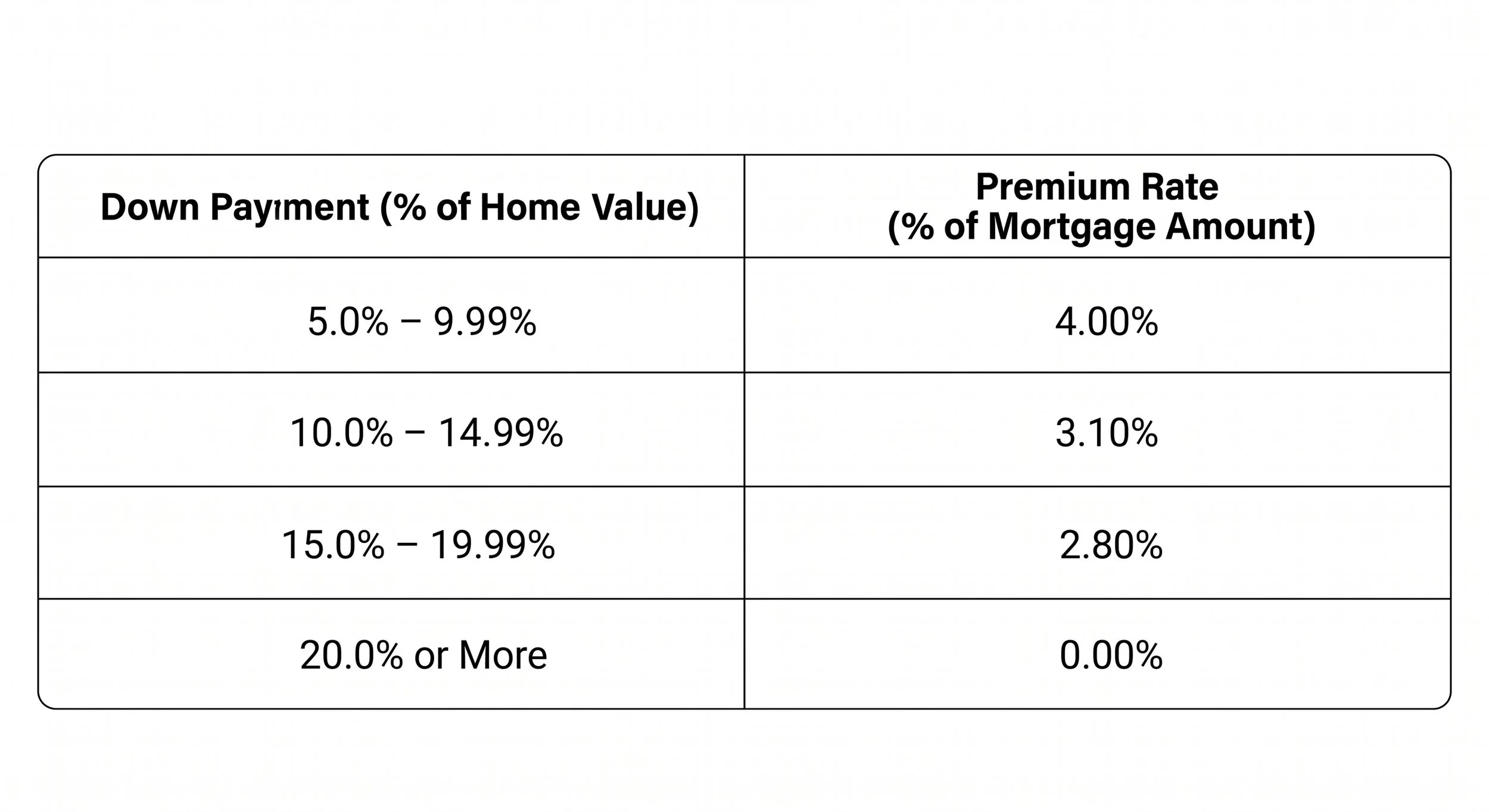
Mortgage Insurance Premiums
The premium is calculated on the mortgage amount, not the purchase price, and is generally be added to the mortgage. In Ontario, provincial sales tax on the insurance premium is payable separately and cannot be added to the mortgage.
The First-Time Buyer Programs You Need to Know
First Home Savings Account (FHSA)
Eligible first-time buyers can generally contribute up to $8,000 per year, with a $40,000 lifetime limit. Contributions are generally tax-deductible and qualifying withdrawals to buy a first home are tax-free. Your FHSA room starts when you open your first FHSA, so opening one early can matter.
RRSP Home Buyers’ Plan (HBP)
The HBP currently allows eligible buyers to withdraw up to $60,000 from an RRSP for a qualifying home. You can potentially use the HBP and FHSA for the same purchase if you meet the rules. For first withdrawals made from 2026 through 2028, the repayment period start is temporarily deferred by an additional three years.
Ontario First-Time Home Buyer Land Transfer Tax Refund
Eligible Ontario first-time buyers can receive a refund of up to $4,000. The rules are specific, including previous ownership anywhere in the world and principal-residence requirements.
Toronto Municipal Land Transfer Tax Rebate
If you are buying in the City of Toronto and qualify, you may receive a separate municipal first-time buyer rebate of up to $4,475. This can be in addition to the Ontario rebate.
First-Time Home Buyers’ GST/HST Rebate
For eligible newly built or substantially renovated homes, the federal first-time buyer GST/HST rebate can provide up to $50,000. In Ontario, the first-time home buyer rebate can provide up to $80,000 of relief on the provincial portion of HST, subject to eligibility and the applicable rules.
30-Year Insured Amortization
Eligible first-time buyers can access up to a 30-year amortization on insured mortgages, subject to program requirements. A longer amortization can reduce the required monthly payment, but it can also increase total interest paid over time. Compare 25 vs. 30 years before choosing.
Closing Costs
Your down payment is only one part of the cash you need to buy a home. Budget for closing costs such as land transfer tax, legal fees, title insurance, inspection, appraisal where applicable, property-tax adjustments, condo adjustments, insurance, moving costs and other transaction-specific expenses.
Do not automatically put every dollar you have into the down payment. Keeping an emergency fund and cash for the first few months of homeownership can be just as important. A general rule of thumb is that your total closing costs will be roughly 1.5% of the purchase price.
First-Time Buyers With Self-Employment or Other Income
Self-employed buyers can qualify for mortgages, but income may be assessed differently. Lenders can look at tax returns, Notices of Assessment, financial statements, business history, business income, corporate income, shareholder income and other documentation.
Having student loans, car loans, credit cards or a line of credit does not automatically disqualify you. The key is understanding how those payments affect affordability and finding the right lender.
Credit: What You Should Know Before Applying
There is no single credit score that guarantees mortgage approval. Lenders can review your payment history, balances, utilization, length of credit history, recent inquiries and overall debt.
If you plan to buy within the next 6–12 months, avoid major credit changes, new loans or large purchases without first understanding how they could affect your qualification.
New Construction vs. Resale
Resale homes can offer established neighbourhoods, easier viewing of the finished product and potentially immediate possession. New construction can offer modern finishes, warranty protection and access to certain GST/HST incentives and eligible insured financing options.
New construction can also involve occupancy periods, builder adjustments, development charges, HST/GST considerations and construction delays. Compare the total cost—not just the advertised purchase price.
Purchase Plus Improvements: Make Your First Home Feel Perfect
You do not always need to buy a fully renovated home. If you find a home in the right location with the right layout but it needs work, an eligible Purchase Plus Improvements / CMHC Improvement strategy may allow qualifying improvement costs to be incorporated into insured mortgage financing, subject to lender, insurer, appraisal and program requirements.
CMHC Improvement can allow eligible owner-occupied 1–4 unit properties to be financed based on the property’s as-improved value, with applicable loan-to-value limits. The improvements must meet the program’s requirements and the lender/insurer may require quotes, plans, documentation and verification.
What Could You Improve?
Depending on the property, lender and program, improvements may include eligible kitchen or bathroom renovations, flooring, windows, doors, roofing, insulation, heating/HVAC upgrades, basement improvements and other qualifying repairs or upgrades.
Energy-efficient improvements may also qualify for CMHC Eco Products, which can provide a partial insurance premium refund when the applicable requirements are met.
A Simple Example
You find a $725,000 home that needs $50,000 of eligible improvements. Another home costs $800,000 but is already renovated. Instead of automatically choosing the renovated home, compare the purchase price, renovation budget, financing, resulting value, monthly payment and total cash required. The less expensive home may give you an opportunity to create the home you actually want.
Important: Purchase Plus Improvements is not free renovation money. The costs become part of your overall financing and the program has rules. The financing should be structured before you buy, not after closing.
First-Time Home Buyer Mistakes to Avoid
Waiting until you have 20% down when you may be able to buy sooner.
Putting every dollar into the down payment and having no emergency fund.
Shopping at the lender’s maximum approval instead of your comfortable payment.
Assuming the lowest mortgage rate is automatically the best mortgage.
Taking on a new car loan or credit card before closing.
Moving large amounts of money without keeping documentation.
Changing employment or income structure before closing without discussing it.
Assuming every lender treats self-employed income, bonuses or credit issues the same way.
Forgetting closing costs.
Waiting until you find a home before speaking with a mortgage professional.
Buying a fully renovated home without comparing it to a home with renovation potential.
Assuming one first-time buyer program automatically makes you eligible for every other program.

Why Work With Aarna Wealth?
Compare More Than One Bank - We can compare mortgage solutions across a range of lenders instead of limiting you to a single bank.
Build the Right Down Payment Strategy - We can compare 5%, 10%, 15% and 20% down and show the impact on insurance, rate, payment and cash remaining.
Find Available First-Time Buyer Programs - We help you identify programs and incentives that may apply to your purchase.
Plan Around Your Real Budget - We focus on a payment that works for your life—not simply the maximum a lender will approve.
Plan Renovations - If the right home needs work, we can assess whether Purchase Plus Improvements / CMHC Improvement may fit.
Guide You From Pre-Approval to Closing - Your mortgage strategy should not end when you get pre-approved. We help you understand the financing through the purchase and closing process.
Your First Home Starts With a Conversation - You do not need to have everything figured out. You do not necessarily need 20% down. And you do not need to be a mortgage expert.
Frequently Asked Questions
-
No. It depends on the mortgage rate, insurance premium, monthly payment, cash remaining and your financial goals.
-
The lender arranges the insurance, but the cost is generally passed to the borrower through the mortgage insurance premium.
-
No. Mortgage default insurance protects the lender against certain losses if the borrower defaults.
-
Potentially. A non-repayable financial gift from an immediate family member can be an acceptable source of down payment, subject to lender and insurer requirements and documentation. We can help you understand what paperwork is needed.
-
Your maximum mortgage is not the same thing as your ideal budget. Lenders may consider employment income, self-employment income, commission, bonuses, overtime, rental income, existing debts, credit, down payment, property taxes, heating costs, condo fees and the applicable qualification rules.
We help you look beyond the maximum approval and build a payment that fits your actual lifestyle.