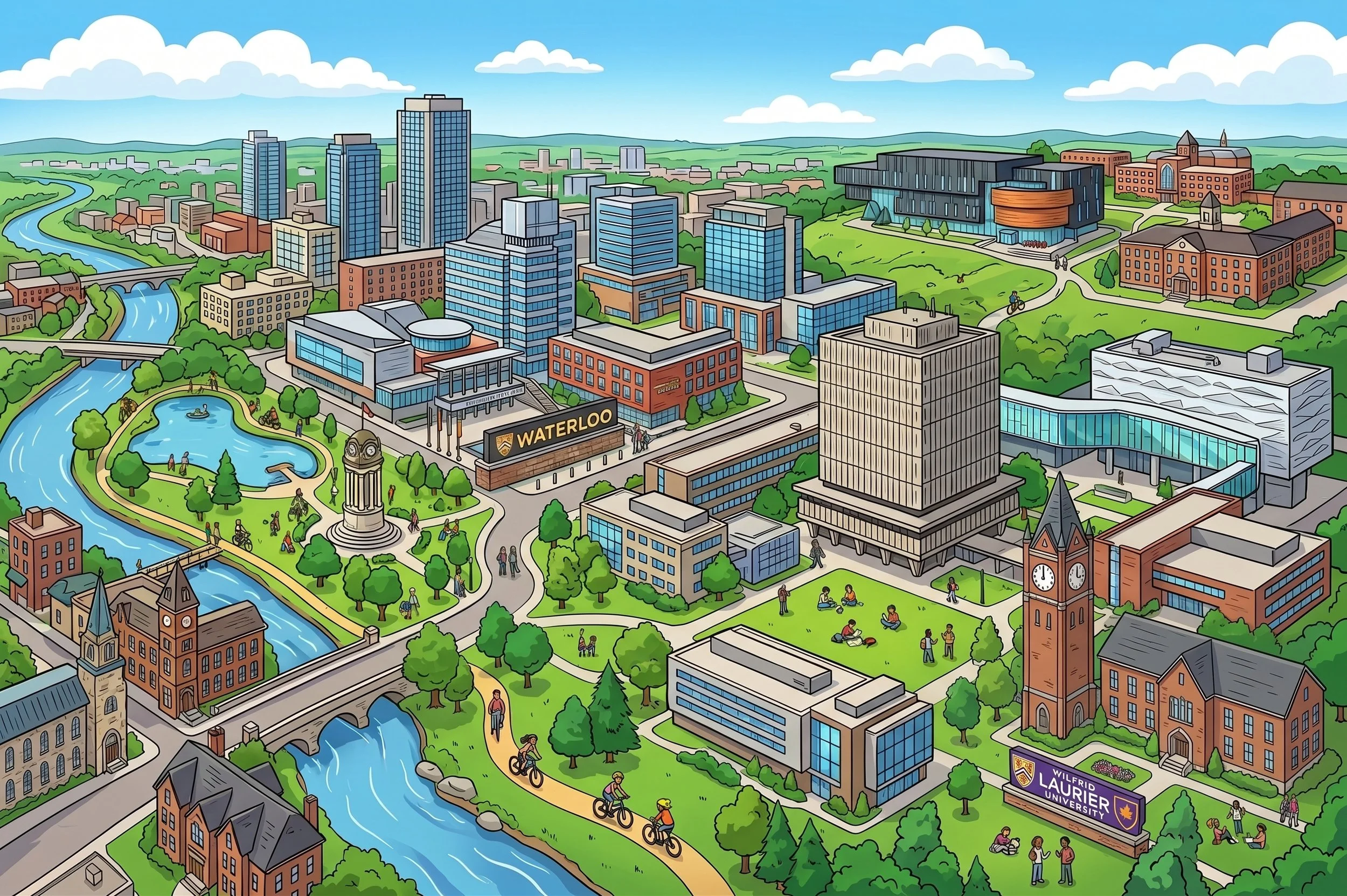
Kitchener-Waterloo-Cambridge
Kitchener–Waterloo–Cambridge Real Estate & Homeownership SWOT Analysis
The Kitchener–Waterloo–Cambridge area is one of Ontario's major technology and innovation hubs. It combines urban amenities, strong employment opportunities, established neighbourhoods and rapidly growing communities, making it attractive to first-time buyers, families, professionals and investors.
The region is centred around Kitchener, Waterloo and Cambridge, with nearby communities such as Woolwich, Wilmot, Wellesley and North Dumfries also contributing to the broader housing market.
Strengths
Strong economy: A major technology, education, healthcare and advanced-manufacturing hub.
More affordable than Toronto: Many buyers can find more space for their money compared with the GTA.
Strong employment: Major employers, universities and a growing technology sector support housing demand.
Excellent schools: Strong public and Catholic schools plus University of Waterloo, Wilfrid Laurier University and Conestoga College.
Growing communities: Significant residential and infrastructure development continues throughout the region.
Good lifestyle: A mix of urban amenities, parks, trails and smaller communities.
Weaknesses
Rapid growth: Population growth has placed pressure on roads, transit, healthcare, schools and other infrastructure.
Rising housing costs: While generally more affordable than Toronto, prices have increased significantly over the years.
Traffic: Growing populations and commuting between the three cities can create congestion.
Transit limitations: Public transit is improving but does not provide the same coverage as Toronto.
Competitive housing pockets: Desirable neighbourhoods and properties can still attract significant buyer interest.
Opportunities
First-time buyers: Relative affordability compared with Toronto and surrounding GTA markets can make the region attractive for new homeowners.
Young professionals: The technology sector and universities create a large population of younger buyers and renters.
Growing families: Many communities offer larger homes, schools and recreational facilities.
New construction: Continued population growth is creating new condos, townhomes and detached-home communities.
Investors: A large student population and growing employment base support rental demand.
Long-term growth: Continued investment in technology, infrastructure and employment should support future housing demand.
Threats
Affordability: Rising prices and mortgage rates can still make homeownership difficult.
Infrastructure pressure: Rapid population growth can outpace roads, transit, healthcare and schools.
Economic sensitivity: The technology and manufacturing sectors can be affected by economic downturns.
Commuting costs: Buyers who work in Toronto or the GTA should consider the time and cost of longer-distance commuting.
Development pressure: Rapid expansion can change established communities and increase demand for municipal services.
Major Cities and Communities
Kitchener
The largest city in the region and a major centre for technology, manufacturing, healthcare and education.
Popular for: First-time buyers, young professionals, families and investors.
Notable areas include Downtown Kitchener, Doon, Forest Heights, Stanley Park, Grand River North and Huron Park.
Waterloo
Known for its universities, technology sector and highly educated population.
Popular for: Students, young professionals, technology workers, families and investors.
Notable areas include Uptown Waterloo, Laurelwood, Beechwood, Columbia and Eastbridge.
Cambridge
Offers a more traditional small-city feel with established neighbourhoods, newer developments and access to major employment centres.
Popular for: Families, first-time buyers and buyers looking for more space.
Notable areas include Galt, Hespeler, Preston, Blair and West Galt.
Woolwich
A growing rural municipality located north of Waterloo, including communities such as Elmira and St. Jacobs.
Popular for: Families and buyers looking for a quieter lifestyle with more space.
Wilmot
Includes communities such as New Hamburg and Baden, offering a small-town lifestyle while remaining close to Kitchener-Waterloo.
Popular for: Families, commuters and buyers looking for more space.
Wellesley
A smaller rural community offering a quieter lifestyle and access to the amenities of the Kitchener-Waterloo area.
Popular for: Families and buyers seeking rural or small-town living.
North Dumfries
Includes communities such as Ayr, offering a growing residential market with access to Cambridge and Kitchener-Waterloo.
Popular for: Families, commuters and buyers looking for newer homes and more space.
Overall
Kitchener–Waterloo–Cambridge is best suited for: First-time buyers, young professionals, families, investors and buyers looking for strong employment opportunities with generally more affordable housing than Toronto.
Kitchener may appeal most to:
First-time buyers, professionals and investors looking for a diverse urban market.
Waterloo may appeal most to:
Technology professionals, students, young professionals and investors.
Cambridge may appeal most to:
Families and buyers looking for more space and a quieter community.
Surrounding Townships may appeal most to:
Buyers looking for larger properties, small-town living and more space.
Biggest Advantage: Strong economic growth, employment opportunities and relative affordability compared with the GTA.
Biggest Challenge: Rapid growth is putting pressure on infrastructure, transportation and housing affordability.
Thinking About Buying, Selling or Refinancing in Kitchener–Waterloo–Cambridge?
Each community offers a different combination of affordability, employment, schools, commute and lifestyle. Understanding these differences can help you choose the right area and mortgage strategy for your long-term goals.